
Eastern Subterranean Termite
Common Name: Eastern subterranean termite
Scientific Name: Reticulitermes flavipes
Introduction.The eastern subterranean termite is the most common and widely distributed termite in North America. It occurs in Canada and southward through the eastern United States and into Mexico and west to Arizona and Utah. This is Missouri's most common and destructive termite.
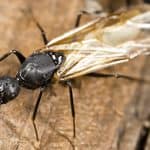
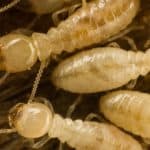
Recognition. The three most recognizable forms (castes) of the eastern subterranean termite are the swarmers (winged reproductives), soldiers and workers. Swarmers are about 3/8 inch long including wings, dark brown to almost black and have 2 pairs of translucent (slightly milky to slightly smoky) wings. The front and hind wings are of equal size. Soldiers are about 1/4 inch long and have an elongated, amber-colored head armed with long jaws. The body is translucent white and the legs are rather short. Workers are 3/16 to 1/4 inch long, translucent white with a nearly round amber head and have rather short legs.
Similar Insects.
(1) The light southeastern subterranean termite (Reticulitermes hageni) swarmer has a pale yellowish-brown body.
(2) The southeastern subterranean termite (Reticulitermes virginicus) swarmer is so like the eastern subterranean termite swarmer that only a specialist can differentiate them.
(3) Non-winged barklice, a.k.a. booklice and psocids, (Order Psocoptera) are similar to termite workers except for the antennae. Barklice have long, thin antennae while termites have rather short antennae that look like strings of beads.Damage. Subterranean termites eat only spring wood and leave the lignin-containing summer wood which they cannot effectively digest. Hence, damaged wood appears to be layered. Also, soil and fecal smears are typically found in the galleries.
A typical mature colony may consist of 60,000 to several hundred thousand workers. Sixty thousand workers can eat 1/5 ounce of wood each day. At this rate, such a colony could completely consume 2 1/3 linear feet of a pine 2 x 4 board in 1 year. However, there may be several colonies associated with a single building and several wood sources being utilized by a given colony.
Biology. Eastern subterranean termites have 3 castes: worker, soldier, and reproductive (primary and supplementary). Colony founding via swarmers (alates) proceeds with the swarmers associating in pairs, breaking off their wings, and burrowing into the soil. Here they mate and only a few eggs are produced the first year. When the queen is mature she will produce about 5,000 to 10,000 eggs a year. The queen may live up to 30 years and workers may live up to 5 years.
Several years are required before the colony reaches the typical mature size of 60,000 or more workers. Under ideal conditions a few swarmers may be produced after 3 to 4 years. Swarming typically occurs during the spring but it may possibly be followed by one or more smaller swarms until winter. Swarming occurs during the daytime, typically during the morning of the day following a warm rain.
Colony distribution is patchy, because they are usually spread in infested wood and wood products such as lumber and firewood. Colony size is much larger, with colonies of 2 to 3 million foragers not uncommon. These large colonies forage over an area of about 3-12,000 square feet. They actively feed in trees and freestanding poles, in addition to structures.
Habits. Eastern subterranean termite colonies are usually located in the ground. They are usually located below the frost line, but above the water table and rock formations. Mud (shelter) tubes are built to bridge areas of adverse conditions between the colony and food sources. They can enter structures through cracks less than 1/16 inch wide. However, if a constant source of moisture is available (like leaky pipes), colonies (called secondary colonies) can exist above ground and without ground contact. Also, true aerial colonies (having no ground contact) are known to exist.
Professional Control. Control of an existing infestation may involve up to 3 methods: (1) Rottler technicians can apply a chemical barrier between the termite colony and the wood of the structure using a residual termiticide liquid treatment of the soil and grade material abutting and beneath the foundation; (2) Structural wood and other cellulose-containing components of houses and other buildings can be treated with a penetrating residual liquid preservative having insecticidal qualities. (3) A baiting system can be installed and monitored on the premises to eliminate invasive termite colonies.
Preventative control also may involve one of 3 methods: (1) A liquid termiticide barrier treatment can be applied to the soil beneath and beside the foundation during the building construction process. This is called a preconstruction treatment. (2) A physical barrier of specially laminated plastic sheeting or stainless steel mesh can be spread across the foundation site after the footer and foundation walls are in place but before the cement slab floor has been poured. (3) A baiting system can be installed and monitored on the premises to detect termite foraging activity.
Cultural Control & Preventative Measures. All wood-to-soil contact must be eliminated. This includes soil and mulch contact with wood and shingle siding, window frames, wooden threshold components and door jambs. All wood debris must be removed from soil-floor crawlspaces. Deck and fence posts, as well as landscaping timbers, should be of commercially treated wood. Firewood piles, stacks of spare lumber and scrap wood should be stored off the ground on blocks. The wood moisture content of structures should be reduced to below 20% by (1) structural and plumbing repairs, (2) correct landscaping practices, (3) indoor ventilation enhancement, (4) strategic dehumidification and/or (5) efficient air conditioning.
Secondary and aerial termite colonies are controlled, for the most part, by correcting the moisture problem and drying out the moisture source in roofing and exterior walls.
Click here to request additional information or to schedule your free inspection to determine treatment recommendations.
Locations
Serving the St. Louis Metropolitan area since 1956, including Arnold, Ballwin, Chesterfield, Crestwood, Creve Coeur, Des Peres, Fenton, Florissant, Kirkwood, Maryland Heights, Overland, St. Charles, Webster Groves, Wentzville and surrounding areas.
Columbia & Jefferson City, MO and surrounding areas.