
Common Spiders
Common Invasive Spiders
Common Names: Black widow spiders/Brown recluse, brown spiders, hourglass spiders or violin spiders
Scientific Names: Latrodectus species/Loxosceles species
Introduction
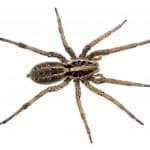
Spiders are arthropods that belong to the class Arachnida and order Araneae. Spiders have two body regions (unlike insects, which have three): the cephalothorax (head fused with thorax) and abdomen (sac-like and unsegmented). Spiders have 8 legs (unlike insects, which have 6), a pair of jaws (chelicerae), a pair of feeler-like pedipalps, one on either side of the jaws and either 8 eyes or, less commonly, 6 eyes. All spiders are predators and produce venom with which they subdue their prey and defend themselves. Over 37,000 species of spiders occur worldwide, including over 3,000 species in Europe and about 3,600 species in the United States and Canada.
Relatively few families of spiders commonly enter human structures in the Midwest and those that do are usually not considered to be dangerous. Representative species of the five most commonly-encountered indoor (structure-invading) spider families are discussed here.
Recognition
Spiders are grouped into families on the basis of eye number (6 or 8), eye size and their arrangement on the cephalothorax. Other identifying features include the arrangement of the spinnerets (silk-producing organs spigots from which liquid silk is extruded from the abdomen) and claws at the tips of the legs. Species are distinguished on the basis of the visible genitalia or sex organs: the epigynum on the underside of the females abdomen and the tibia (tip) of the male pedipalp, which is used to transfer sperm to the female.
In some spider families, the females are larger than the males and are colored differently. In other families, the males are larger (i.e., have longer legs) but spindly in comparison to the stocky females. In every case, the females have larger abdomens to accommodate the considerable ovaries and volume of eggs produced. Males, on the other hand, have characteristically enlarged tips (tibia) on their pedipalps, often giving the impression of wearing boxing gloves on these appendages.
Representative Species
Widows or hourglass spiders: North America is home to 5 species of widows or hourglass spiders, including 3 species of black widow (southern, northern and western), a brown widow and a red widow. Most of these inhabit the South and Southwest. However, there are 2 species of black widow spiders that have been found in the Midwest.
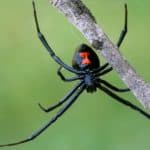
The northern widow, Latrodectus variolus, adult female body is 1/3 to 1/2 inch long, shiny black or brownish-black, and has a row of 3 or 4 small red spots on the rear half of the upper abdomen, in addition to the characteristic red hourglass pattern on the underside of the nearly spherical abdomen. The hourglass pattern sometimes has the narrowed middle part missing on some individuals. The legs are slender and fairly long, allowing for a leg span of 1 1/2 inches. Males are much smaller and have red or orange spots more prominently visible on the abdomen. Like its less toxic relatives, the cobweb spiders (also of the family Theridiidae), the northern widow spins a strong, irregular web in dark, protected sites including barns, sheds, outhouses, pump shelters, meter boxes, hot tub understructures, recessed storage hutches/nooks, under decks and among woodpiles. Females deposit 185 to 464 eggs in round or teardrop-shaped silken egg sacs that measure about 1/2 inch in diameter. Several egg sacs may be produced by each female during the summer. The spiderlings hatch in 8 to 30 days and undergo 4 to 9 instars (growth stages between molts). This occurs over 54 to 107 days. Most of the offspring overwinter as juveniles and complete their development in the spring. Female widow spiders may live up to 3 years while males live for a year or less.
The southern or definitive black widow, Latrodectus mactans, occasionally shows up in Midwestern outbuildings and around residences. It sometimes is re-introduced as a stow-away in goods trucked here from the south as well as in bulk foods and produce imported from Mexico. Black widows may become established in warehouses, factories and stores that receive spider-occupied parts and products. The black widow is very much like the northern widow but the females usually have a completely black upper abdomen and the red hourglass marking on the abdomen underside is usually complete. Female black widows spiders are usually not aggressive against humans contacting their webs, except for when they are guarding their egg sacs. The bite of either species, although not painful in itself, will begin with slight local swelling and result in severe muscle cramps, fever, nausea, sweating, disorientation and other symptoms resulting from the strong neurotoxin component of the venom. A healthy person will recover after 24 to 48 hours of suffering. The bite is rarely fatal, except in cases involving infants and the infirm. Antitoxin is available at hospitals equipped with poison control centers (e.g., Childrens Hospital in Columbus).
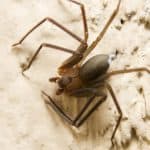
Brown spiders or recluses: The continental U.S. is home to 6 species of brown spiders belonging to the family Loxoscelidae. These spiders are also referred to as violin spiders and fiddle-back spiders because of a violin-shaped, darker brown pattern on the cephalothorax of these spiders. The Loxosceles brown spiders are similar in coloration, having a light brown cephalothorax outer margin, light brown or beige abdomen and medium to dark brown legs and violin pattern on the cephalothorax. The eye pattern is characteristic for this family and constitutes the most reliable method for identification. The six dark eyes are arranged in 3 pairs (3 diads). One diad is located on the front middle portion of the face and the other 2 diads are located on either side. The 3 diads lie along the lower rim of the violin shape.
The brown recluse, Loxosceles reclusa, is the best-known of this family and is most common in the south and southwest. Adults range 1/4 to 3/8 inch in body length and have a leg span of 1 to 1 1/2 inch. Males are similar in size to females but have slender abdomens. When disturbed, the legs are frequently held in a somewhat crablike posture with the 3 front pairs of legs arching forward and the hind legs arched backward. Brown recluse spiders actively hunt for small prey through the night and in darkened rooms during the day. Females spin thin silk retreats in undisturbed sites where they spend the daylight hours. Such sites include seldom-used hanging clothing and shoes in closets, the lower folds and plaits of curtains, draperies, and the skirting around sofas, stuffed chairs and beds. Other sites may be among storage (especially cardboard boxes and papers) and clutter in warm attics, basements and garages, also under the edges of carpeting and behind baseboards. In commercial buildings, heat tunnels and boiler rooms may harbor these spiders. Outdoor harborages are usually not an issue in the Midwest as they are in the south. The female produces 1 to 5 silken egg sacs during their lifetime, each typically containing 30 to 50 eggs (maximum 300). The eggs hatch in 25 to 39 days and the spiderlings undergo 8 instars (growth stages between molts). Development requires about a year. Indoors, females live 2 to 5 years while the male lifespan is under 2 years.
The bite of a brown recluse or Mediterranean recluse may not be felt; or in some cases, may produce an immediate stinging sensation. The cytotoxic venom produces a necrosis of the skin and underlying tissue, resulting in an ulcerating type of sore. Other symptoms may include restlessness and fever. The killed tissue gradually sloughs away during a 10 to 14 day period following the bite, leaving an open ulcer that does not readily heal. Without medical attention, healing occurs very slowly, requiring several weeks and resulting in dense scar tissue. In severe cases, plastic surgery may be required. Persons who are experiencing the early signs of brown spider envenomization should seek medical attention immediately. Treatment may involve the cleaning of the wound and administering of corticosteroids and antibiotics by a physician.
Most cases of bites attributed to these 2 species by the public and by healthcare professionals are false and speculative. Other insect and spider bites (e.g., those of yellow sac spiders and funnelweaver or grass spiders) and/or secondary bacterial infections are more likely responsible for the lesser incidents that have been reported by those involved. It is important for the person who is bitten to seek out and save a specimen of the spider that inflicted the bite for the healthcare professional or consulting entomologist to identify, if possible.
Similar Groups
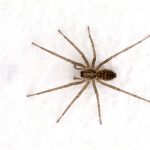
(1) Some slender, brown crab spiders of the family Philodromidae are similar to the more venomous brown recluse and Mediterranean recluse. However, the crab spiders in the Midwest have 8 eyes while the brown spiders have 6 eyes arranged in 3 pairs, called diads (one pair in front and a pair on either side of the cephalothorax). (2) Black jumping spiders of the genus Phidippus (family Salticidae) are sometimes mistaken for the black widow spiders, Latrodectus mactans and Latrodectus variolus (family Theridiidae). However, jumping spiders are active hunters, stocky, short-legged, velvety or hairy-looking and have a few white and yellow markings on top of the abdomen; whereas, black widow spiders are web-dwellers, have rounded abdomens, smooth, shiny bodies, longer spindly legs and have a red hourglass pattern on the underside of the abdomen and possibly a row of 3 or 4 small red dots on the rear half of the upper abdomen (Latrodectus variolus).
Biology
Spiders exhibit gradual metamorphosis (growth) in which hatchlings are nearly identical to adults (e.g., the brown or recluse spiders of the family Loxoscelidae), except for some coloration differences (e.g., widows / hourglass spiders and other cobweb spiders of the family Theridiidae). Spiders molt several times before reaching adulthood. Some spiders (including the widows and brown spiders) spend the winter as hibernating juveniles or adults outdoors or remain active indoors; while others overwinter in the egg stage (e.g., orbweavers).
Spiders feed by injecting digestive enzymes through their hollow jaws (chelicerae) into their venom-subdued prey. The jaws are used to masticate or soften the prey and distribute the enzymes throughout the dinner guest. Much digestion occurs before the prey is consumed. The spider ingests by pumping the semi-liquefied prey into its mouth and esophagus.
Spiders generally require a season, or a summer and the following spring, to complete development. Spider longevity depends on the species, gender and environment. Most spiders live only one year in temperate climates. However, the life span may be extended under ideal circumstances, including availability of food, warmth and protection. Depending on the species, females may produce one egg sac full of eggs or several egg sacs during the course of their adult lives. Female spiders often guard their eggs within a protective silken retreat until the young hatch or until the females die.
Habits
Spiders often are categorized on the basis of how they capture prey. Those which rely upon silken webs, capture prey by ensnarement (e.g., the widow or hourglass spiders and other cobweb spiders). Spiders that wander about searching for prey are active hunters (e.g., the brown spiders or recluse spiders). Finally, spiders that rely on stealth, waiting for prey to approach unawares, are passive hunters (e.g., crab spiders). Favorite prey include most soft-bodied insects, such as flies, moths, mayflies, crickets, cockroaches and silverfish, as well as other spiders. All spiders have spinnerets which produce silk; however, not all spiders spin webs. The brown or recluse spiders, spin thin silk retreats in which to rest during the daytime. Thicker silk retreats are constructed in which to spend the winter or to house a batch of eggs, which, in turn, may be wrapped in a silken egg sac for protection. Many species spin a silken dragline as they move along surfaces, just in case they lose their footing or have to let go in order to escape danger or to descend to a lower level in order to continue their search for prey.
Spiders that capture prey by ensnarement spin characteristically functional webs that consist of non-sticky bridge and connector strands (used by the spider to move about) as well as sticky strands on which to capture prey. Silk may be used to wrap and suspend freshly caught prey until the spider decides to feed. The ability of spiders to traverse long distances may be attributed to the behavior called ballooningÂ. In springtime, when spiderlings hatch from overwintered eggs (e.g., cobweb spiders), they climb to an upper perch and spin out long strands of silk that are wafted by the breeze. When the strands are long enough for the wind to carry the spiderlings from their perches, they become airborne and balloon to new and promising web-building sites. In this way, spiderlings may be carried to the tops of tall buildings and natural formations. Spiders often construct webs near electric lights because flying insect prey is abundant at such locations through the night.
In general, male spiders approach the females with caution in order to mate; if accepted, they use their pedipalps to transfer sperm to the female epigynum. Once mating is completed, males may become a post-copulatory feast for the females, unless there is an abundance of prey in the vicinity and the females are well-fed.
Cultural Control And Preventative Measures
The likelihood of introducing dangerous spiders within structures and encountering them in and around buildings can be reduced by: (1) eliminating tall and dense vegetation close to the foundation which serve as harborage for spiders and their prey (e.g., vines, groundcover, juniper, uncut grass and weeds), (2) excluding gaps under doors (by replacing or adding door sweeps), lower courses of siding (using silicone sealer), around utility penetrations (using builder's putty) and weep holes in brick veneer (by filling with copper gauze), (3) capturing wandering spiders on ground level, in basements and in attached garages by placing sticky traps (glue boards) indoors along walls behind furniture, washer, dryer, sump pump, water heater, furnace, commode and storage (out of reach of children and pets) and (4) removal using a shop vacuum cleaner or household vacuum fitted with a hose attachment; this is useful for removing spider webs as well, (5) thoroughly inspecting goods and produce trucked in from the south, southwest and from Mexico on the loading dock or receiving area for stowaway spiders before storage, processing and distribution occur and (6) carefully check little-used clothing and shoes before wearing (if brown spiders are a problem in the structure).
Professional Control
A Rottler technician will apply an exterior barrier treatment using residual liquid insecticide around the foundation perimeter, beneath lower siding, under eaves and porticos, along exterior molding/trim, thresholds, patio, deck and chimney attachments, as well as inside and around sheds and other outbuildings. Residual liquid insecticides may be use to treat mulch and landscaping features located close to the foundation, as well. A quarterly pest management service program may be required in cases where large populations of spiders are present and where landscaping conditions and locality are conducive to their propagation. Indoors, basement sillplates and perimeters, as well as the corners and edges of spider-infested rooms, can be lightly treated using an insecticide aerosol. Pest sticky monitors/traps will be placed strategically to help reduce indoor spider activity.
Brown spider infestations will be addressed via: (1) inspection and vacuuming among stored items in warm, undisturbed areas of attics, basements, garages and living spaces, including beneath skirted sofas, stuffed chairs and bed frames; (2) insecticide aerosol treatments behind the baseboards and into the voids of outside walls, where these spiders find food and harborage.
Click here to request additional information or to schedule your free inspection to determine treatment recommendations.
Locations
Serving the St. Louis Metropolitan area since 1956, including Arnold, Ballwin, Chesterfield, Crestwood, Creve Coeur, Des Peres, Fenton, Florissant, Kirkwood, Maryland Heights, Overland, St. Charles, Webster Groves, Wentzville and surrounding areas.
Columbia & Jefferson City, MO and surrounding areas.