
NEW AT ROTTLER


Bed Bug

Common Name:Bed bug
Scientific Name:Cimex lectularius

Introduction. This insect probably received its common name of bed bug from its close association with human sleeping beds where it often seeks refuge during daylight, only to come out to feed on the beds occupant(s) at night. The bed bug is an ectoparasite of primarily humans but will also attack poultry, caged and invasive birds and various mammals, including rodents. It was introduced into the United States with the early colonists. It is found throughout the United States and the world.

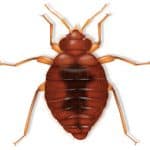
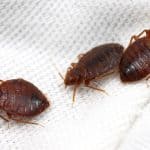
Recognition. Adults measure 3/16 inch long; and are broadly oval and flat. Bed bugs are amber to reddish brown in color, depending on how recently they fed. When present in sufficient numbers, it is possible to detect an obnoxiously sweet or foul locker room odor, which is emitted from their glands.

Similar Insects. Bat bugs (Cimex adjunctus) have the upper surface of body covered with longer hairs (setae) and have less-indented shoulders at the front edge of the thorax. [See photo comparison on page 3.]

Biology. Female bed bugs lay 1 to 5 eggs per day with the 1/32 inch long, white eggs being deposited individually in cracks or on rough surfaces and secured with a transparent cement for an average total of 200 eggs; maximum eggs per day is 12, with 541 for a lifetime. There are 5 nymphal instars with a blood meal required for each molt. About 3 to 10 minutes are required for each blood meal, during which saliva containing an anticoagulant is injected. Developmental time (egg to adult) takes 21 days at 86F to 120 days at 65F. The threshold for egg hatching, nymphal development, and adult activity is 55 to 59F. Below 61F adults enter semi-hibernation and the heat stress death point is 111 to 113F.
Without a blood meal, once-fed nymphs can survive an average of 51 days (range 28 to 73) at 81F and 70 to 75% RH. Being poorly fed can greatly prolong the life cycle (up to several years in some studies). With normal feeding and reproductive cycles, individuals can live up to 316 days. Not all bed bugs in a residence will feed concurrently. They remain concealed until hungry. Humans are the preferred host of these insects but in their absence bed bugs will feed on poultry, canaries, English sparrows, mice, rats, rabbits, guinea pigs, and bats.
Although the bite of bed bugs is painless, most people (80%) develop an allergic reaction to the saliva injected by the bug as it feeds. A swelling usually results from feeding but there is no red spot such as is characteristic with flea bites. Swelling may be severe and extend beyond the immediate bite area in highly sensitive individuals. Although bed bugs have been suspect in the transmission of many diseases or disease organisms in humans, in most cases conclusive evidence is lacking.

Habits. Bed bugs harbor in cracks and crevices during the day and come out to feed at night. Typically they can be found around mattress buttons and beading, in box springs or their coverings, and in any crevice of a wooden bed frame, such as where members join. Other places to check are wall hangings such as picture frames, night stands, stuffed furniture, baseboards, floorboard cracks, behind loose wallpaper, light switches, door and window frames, conduits, etc. In heavy infestations, bed bugs may be found in wall voids, attics, and other enclosed places. They will crawl considerable distances to obtain a blood meal.
They can be introduced into a structure via used furniture or in the belongings of someone who has been living in a bed bug infested situation. Adults can survive for up to 6-7 months if they are well fed and they can feed on other animals if humans are not present. When the temperature falls below 61F adults enter semi hibernation and can survive for months.
Bed bug infestations have been found in transportation vehicles such as boats (including cruise ships), trains, airplanes, and buses as well as in movie theaters where they typically harborage in seats and associated frames.
Besides the characteristic obnoxiously sweet odor, the other primary clues to an infestation will be the presence of bed bugs and/or small red to reddish brown fecal spots here and there on surfaces.

Cultural Control & Preparatory Measures. Affected persons subject to severe infestations should be provided with alternate lodging or sleeping accommodations until the problem is resolved. If pesticide exposure becomes a health concern, an infested bed frame, box spring and mattress and upholstered furniture can be discarded (after being marked or defaced to prevent adoption by others) and replaced with new. Professionally-treated or replacement mattresses and box springs should be fitted with special zippered encasements to prevent re-infestation by bed bugs. A standard vacuum cleaner fitted with hose attachment and crevice tool is useful to remove bed bugs when found. Microfiltration vacuum bags should be used to prevent insect allergens from being blown into the air. Filter bags should be discarded after vacuuming to prevent escape and re-infestation by surviving bed bugs. Bed coverings, clothing and comfort toys suspected of being infested with bed bugs should be dry cleaned or washed in hot soapy water and run through the medium to high heat cycle in a dryer.

Professional Control. A thorough inspection is indispensable. Rottler will treat any bed bugs found with a crack & crevice application of appropriately labeled insecticides, including an insect growth regulator (IGR). Great care will be taken when treating in order to minimize human exposure to pesticides.
In homes, most bed bug infestations can be controlled with insecticide applications to infested upholstered furniture seams, mattress seams, box spring cavities, bed frame crevices, lower wall penetrations, behind baseboards, and into the carpet tack strip zone. In apartment buildings, adjoining condominiums and hotels, it's advisable to also inspect and treat the units to either side and above and below the infested unit, since bed bugs move readily through structural voids. Additional treatments of infested dwellings may be necessary.


Click here to request additional information or to schedule your free inspection to determine treatment recommendations.

Locations

Serving the St. Louis Metropolitan area since 1956, including Arnold, Ballwin, Chesterfield, Crestwood, Creve Coeur, Des Peres, Fenton, Florissant, Kirkwood, Maryland Heights, Overland, St. Charles, Webster Groves, Wentzville and surrounding areas.

Columbia & Jefferson City, MO and surrounding areas.