
Silverfish
 
Silverfish
print this page

Silverfish

Common Name: Silverfish
Scientific Name: Ctenolepisma lineata and Lepisma saccharina

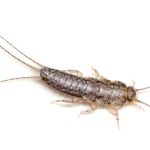
Introduction. Silverfish is a common name for teardrop/fish-shaped insects whose bodies are covered with silvery or gray scales. They have 3 long bristle-like appendages protruding from the rear end of the body, as well as a pair of long antennae.

Recognition. Adult silverfish, not including tails, measure 1/2 to 3/4 inch long. They are wingless with a flattened body, have an elongated shape, tapering from head to rear and are generally covered with fine, powdery scales. Immatures are similar to adults in appearance, except for size. Scales appear with the 3rd or
4th molt.
Representative Species. A larger (2/3 inch-long) species, the four-lined silverfish (Ctenolepisma lineata), has darker gray lines/stripes running the length of the light gray body. The common silverfish (Lepisma saccharina) is solid silver in color and smaller (1/2 inch-long) in size.

Similar Insects. (1) Firebrats (Thermobia domestica) are related insects that lack the silvery sheen but have a fuzzy appearance with charcoal mottling on the mostly beige-gray body. (2) The larvae of black carpet beetles (Attagenus anicolor) are brown, fuzzy and teardropped shaped, have a tassel of hairs at the rear of the body instead of 3 bristles.
Damage and Signs of Infestation. The feeding marks are irregular whether they are holes, notches along an edge, or surface etchings. Yellow stains, scales, and/or feces may be seen on the infested materials.

Biology. The common silverfish (Lepisma saccharina) female lays about 1 to 3 eggs per day, placing them in cracks, under objects, or left exposed. Egg hatch requires 72 to 90°F and at least 50 to 75% relative humidity. Developmental time (egg to adult) is 3 to 4 months under favorable conditions, but may require up to 2 to 3 years otherwise. Immatures molt 4 to 14 times to reach adulthood. Silverfish commonly live about 3 years and may continue to molt periodically in the adult stage. The most favorable conditions are 72 to 80°F with high humidity.
The fourlined silverfish (Ctenolepisma lineata), and probably other silverfish, produce the enzyme cellulase in the midgut and can therefore digest the cellulose content of paper and wood.

Habits. Silverfish hide during the day and prefer to hide or rest in tight cracks or crevices. They can be found almost anywhere in a house including living rooms, bedrooms, bathrooms, attics, basements, and garages. Silverfish also tend to infest older, damp commercial structures such as offices, stores, and libraries. They tend to roam quite some distance while searching for food, but once they find a satisfactory food source, they remain close to it. Within structures, they can be breeding in a variety of areas, including wall voids, in/under subflooring, attics, etc. Silverfish can survive for weeks without food or water.
Common silverfish (Lepisma saccharina) prefer areas of room temperature (70 to 85°F) and high relative humidity (70 to 100%RH). They prefer proteins as well as carbohydrates and are cannibalistic. Silverfish are often introduced into buildings via cardboard cartons of books and papers from an infested location. They are pests of paper, particularly glazed paper and paper with sizing, wallpaper and wallpaper paste, etc. Silverfish eat dried animal proteins and dead or injured of their kind.
The fourlined silverfish is not so limited by temperature and moisture. It may be found throughout a building, in the basement, in wall voids, the attic (especially if the roof has wooden shingles/shakes), and in the garage. Outdoors it occurs in the mulch of foundation planting beds, among landscaping timbers and in stacked stone walls.

Cultural Control & Preventative Measures. The most important steps a property owner can take to reduce silverfish infestations and damage to personal property are:
(1) Correct conducive conditions that allow moisture introduction and retention in buildings and residences. This includes repairing plumbing, roof, skylight and window leaks; keeping indoor relative humidity to the 50 to 60% level by operating the air conditioning and supplemental dehumidifier(s) where needed, avoiding irrigation wetness on exterior walls; and cleaning out clogged rain-gutters and downspouts.
(2) Perform landscape modifications that reduce harborage and moisture close to buildings, such as trimming trees and shrubs away from roofing and exterior surfaces; preventing accumulations of mulch and vegetation close to the foundation; moving landscaping timbers and stones away from the foundation, as well as wood and stacks of lumber and debris.

Professional Control. A Rottler technician will apply an exterior barrier treatment using a residual liquid insecticide upward and outward from the structure foundation. Insecticide may be strategically applied beneath wood siding and shingles and into structural junctures where silverfish enter and breed. Indoors, the technician will apply insecticide bait and/or dust formulations into strategic structural voids through plumbing, electric and light fixture penetrations and possibly attic areas, if accessible, to control silverfish in these sites.


Click here to request additional information or to schedule your free inspection to determine treatment recommendations.

Locations

Serving the St. Louis Metropolitan area since 1956, including Arnold, Ballwin, Chesterfield, Crestwood, Creve Coeur, Des Peres, Fenton, Florissant, Kirkwood, Maryland Heights, Overland, St. Charles, Webster Groves, Wentzville and surrounding areas.

Columbia & Jefferson City, MO and surrounding areas.

Don't see what you're looking for - Ask The Entomologist